Lateral Raise
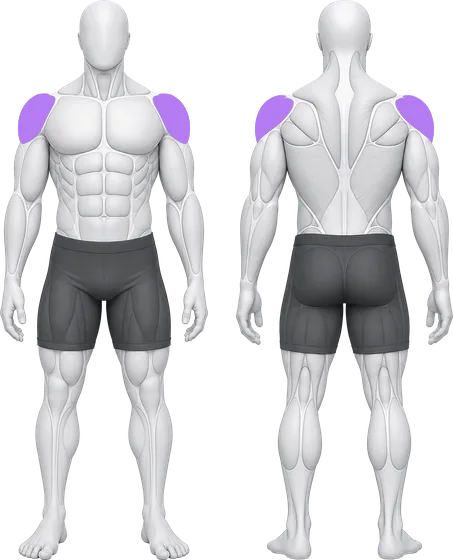
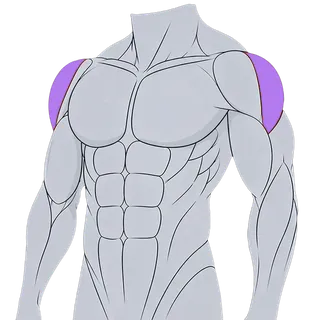
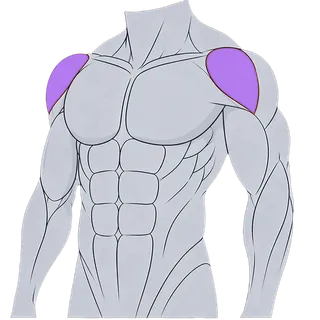
The most direct isolation exercise for your side delts, the part of the shoulder that adds width. It rewards light weights and strict form.
Also known as: dumbbell lateral raise, side lateral raise, DB lateral raise
- Level
- Beginner
- Equipment
- Dumbbell
- Type
- Isolation
How to do it
- Stand with your feet hip-width apart, a dumbbell in each hand by your thighs, palms facing in.
- Soften your elbows and lean your torso slightly forward. Hold that position for the whole set.
- Raise your arms out to the sides, elbows leading your hands, until they reach shoulder height.
- Pause briefly at the top without shrugging toward your ears.
- Lower slowly over 2-3 seconds until the dumbbells nearly touch your thighs, then go straight into the next rep.
Form cues
- Think about pushing the dumbbells out to the walls, not up to the ceiling.
- Lead with your elbows: keep them level with your hands or slightly higher.
- Stop with your arms parallel to the floor. Going higher hands the work to your traps.
Common mistakes
- Going too heavy and swinging: momentum does the lifting and your delts barely work. Drop the weight until you can lift without moving your torso.
- Shrugging: when your traps creep up toward your ears, they steal the tension. Keep your shoulders down for the whole set.
- Letting your wrists rise above your elbows: it strains the elbow and turns the lift into a front raise. Always let the elbow lead.
- Dropping the dumbbells: the lowering phase is half the stimulus. Control it over 2-3 seconds.
Sets and reps
For wider shoulders, do 3-4 sets of 12-20 reps with a weight that leaves 1-2 reps in reserve, resting 60-90 seconds. Side delts are small and recover quickly, so you can train them 2-3 times a week.
Variations
Same movement, different equipment. Pick based on what you have and what you want from lateral raises.
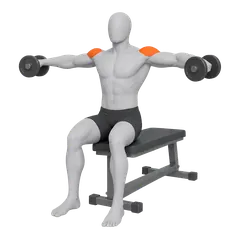
Seated dumbbell lateral raise
Sitting on a bench takes your legs out of it, so only the shoulder lifts.
How to do it
- Sit on a bench with a dumbbell in each hand at your sides.
- Keep your back upright and core braced.
- Raise both dumbbells out to the sides until they reach shoulder height.
- Keep a slight bend in your elbows.
- Lower the dumbbells with control.
- Primary
- Side Delts
- Secondary
- Front Delts, Traps
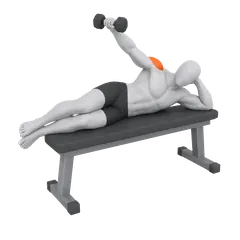
Side-lying lateral raise
One arm at a time. Tension peaks at the bottom, exactly where the standing version barely loads.
How to do it
- Lie on your side on a flat bench with your bottom arm supporting your head or gripping the bench edge.
- Hold a dumbbell in your top hand with your arm resting along your side.
- Keeping your elbow slightly bent, raise the dumbbell upward until your arm is perpendicular to the floor.
- Pause briefly at the top, then lower the dumbbell slowly back to your side.
- Complete all reps on one side before switching.
- Primary
- Side Delts
- Secondary
- Supraspinatus, Traps
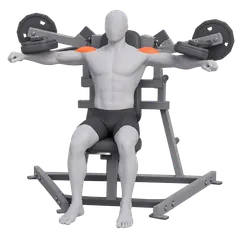
Machine lateral raise
The path is fixed, so you can safely train close to failure.
How to do it
- Set the seat height so that the pivot of the arm pads lines up with the point of your shoulders when you sit down.
- Load the plate horns evenly on both sides and sit with your back flat against the pad.
- Place the outside of your upper arms against the pads with your elbows bent and your arms hanging down.
- Push out and up against the pads until your upper arms are roughly level with your shoulders.
- Lower under control until your arms are back at your sides, and repeat for the desired number of repetitions.
- Primary
- Side Delts
- Secondary
- Front Delts, Traps
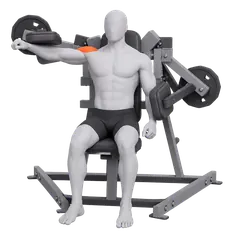
Single-arm machine lateral raise
Helps a lagging shoulder catch up with the other side.
How to do it
- Set the seat height so the pad pivot lines up with your shoulder, and load only the side you are about to work.
- Sit with your back flat against the pad and place the outside of your working upper arm against its pad.
- Hold the handle on the free side or rest that hand in your lap, and keep your torso square to the seat.
- Push the working arm out and up against the pad until the upper arm is level with your shoulder, then lower it under control.
- Complete all the repetitions on that side, then load and work the other side.
- Primary
- Side Delts
- Secondary
- Front Delts, Traps
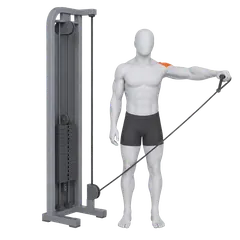
Cable lateral raise
The cable keeps tension through the whole range, including the bottom.
How to do it
- Stand sideways to a low pulley, grip the handle with the outside hand.
- Keep a soft bend in the elbow and the cable in front of the working leg.
- Raise the arm out to the side until parallel to the floor.
- Lower under control. Complete reps per side, then switch.
- Maintain tension — do not let the weight rest at the bottom.
- Primary
- Side Delts
- Secondary
- Front Delts, Traps
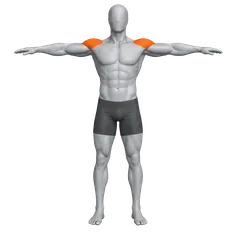
Bodyweight lateral raise
To learn the movement or warm up your shoulders before loading them.
How to do it
- Stand upright with arms hanging at your sides.
- Raise both arms out to the sides with a slight elbow bend until parallel with the floor.
- Pause briefly at the top.
- Lower slowly back to the starting position.
- Primary
- Side Delts
- Secondary
- Front Delts, Traps
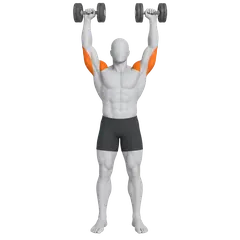
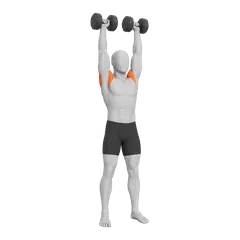
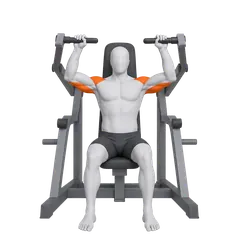
FAQ
Dumbbells or cables for lateral raises?
Both work. Dumbbells load the top of the movement and almost nothing at the bottom, while a cable keeps tension throughout. Rotating them by training block, or using both in the same week, covers the whole range.
How heavy should lateral raises be?
Lighter than you think. Plenty of lifters progress for months with 10-25 lb dumbbells. If you need to swing to get the weight up, it is too heavy.
How high should you raise your arms?
To shoulder height. Above that, your traps take over and the side delts stop doing most of the work.
Do lateral raises make your shoulders wider?
Yes. The side delt is what makes shoulders look wider from the front, and this is the exercise that isolates it best. With consistent training and enough weekly sets, the change shows within a few months.
What muscles do lateral raises work?
They mainly work the side delts, with help from the front delts.
Add lateral raises to your next workout
Log your sets and weights, and see how each muscle progresses in the app.